Method and System for Producing Inorganic Nutrient Salt Solutions from Industrial CO₂-Containing Flue-Gas.
Our invention uses industrial CO₂-containing flue-gas as a carbon source and, via a high-efficiency RPB gas absorption unit, directly produces a utilizable inorganic nutrient salt solution instead of merely separating and storing CO₂, which are not good options.
Overview
CO₂-containing flue-gas at about 5–70 vol% CO₂ is fed without complex pretreatment directly into a gas absorption unit.
An aqueous alkali hydroxide solution (e.g., NaOH, KOH) at about 5–20 wt% is using currently/co-currently with the GHG flue-gas.
The absorption step yields an inorganic liquid solution containing one or more of NaHCO₃, Na₂CO₃, KHCO₃, or K₂CO₃.
This liquid stream is defined as an “inorganic nutrient source” and can be directly utilized for algal cultivation, agricultural applications, or other systems requiring an inorganic carbon source.
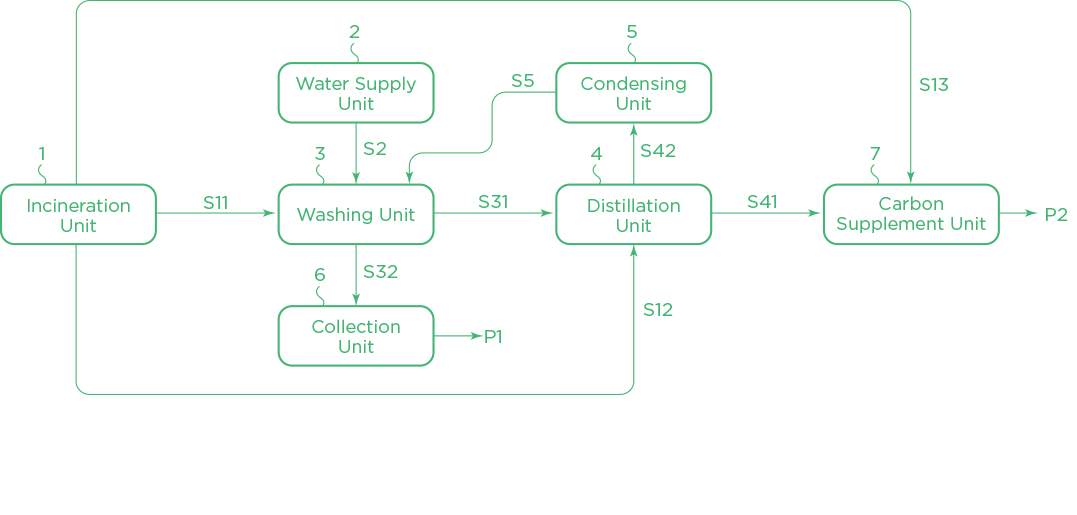
Integrated Fly Ash Washing and Waste-Heat Distillation System Enabled by Our RPB CO₂ Capture System
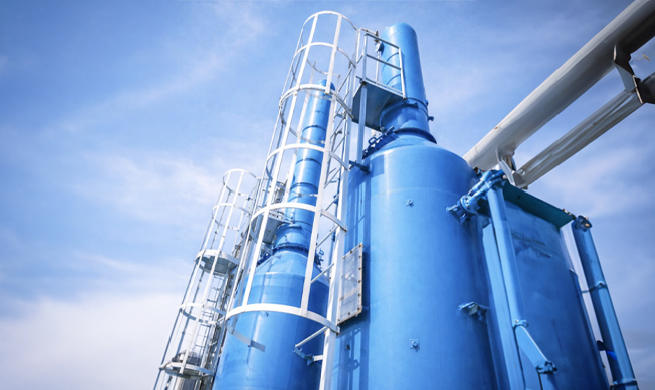
SELF-SUCTIONING GAS CAPTURE DEVICE
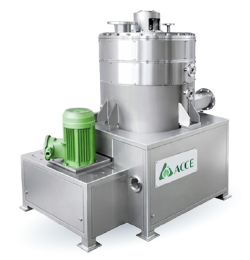
We have developed a self-induced (self-suction) gas capture device comprising an outer cylinder, rotor, stator, fan, and drive assembly to effect intensive gas–liquid contact and absorption inside the unit. With a single motor as the only prime mover, the device draws gas autonomously and vigorously mixes it with the absorbent to capture gases such as CO₂.
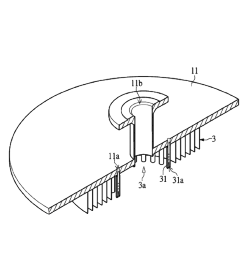
Gas is automatically induced from the bottom of the device by the internal fan, without any external blower. Liquid enters from the top, is discharged through a hollow lance, and distributed into multiple annular sections. During rotation, the rotor shears the liquid through perforations, generating fine droplets and thereby increasing gas–liquid interfacial area. The gas stream flows upward, traversing multiple concentric stages and droplet fields; after absorption, the treated gas is discharged.

